What is Skool?
Skool is a paid community platform that combines a discussion feed, a course classroom, a calendar, and gamification in one product. Every plan includes unlimited members, courses, videos, and live calls, so you never pay more because your community grew.
You create a group, members join through your about page, and everything happens inside: posts, course lessons, events, direct messages, and payments if you charge for access. For the full breakdown of how the platform works, see our plain-English guide to what Skool is.
Is Skool legit?
Yes. Skool is a real platform processing real subscription payments, and my paid community collects its membership fees through it every month. In the last 30 days my dashboard shows 99 new signups and $4,105 in new monthly recurring revenue.
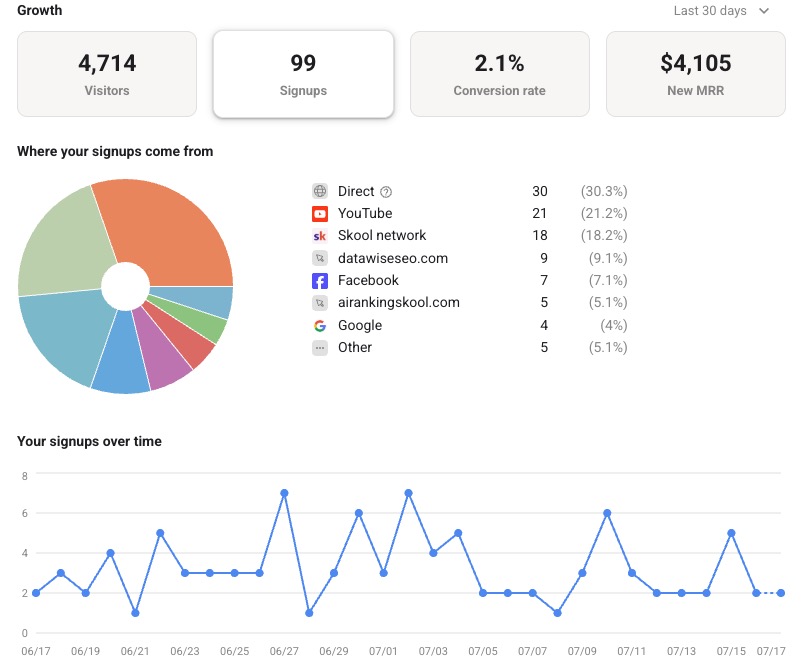
My community's Skool growth dashboard, last 30 days: 4,714 visitors, 99 signups, 2.1% conversion, $4,105 new MRR.
One honest caveat: the platform being legit does not mean every community on it is good. Quality varies enormously from group to group, exactly like YouTube channels do. Judge the community you are about to join, not the software it runs on.
How much does Skool cost?
Skool costs $9 a month on the Hobby plan or $99 a month on Pro, and both include unlimited members, courses, videos, and live calls. What you are really buying with Pro is a lower transaction fee, 2.9% instead of Hobby's 10% on everything your members pay you, plus a custom URL and the member affiliates feature.
The fee difference means the right plan depends entirely on your community revenue. We did the break-even math in our Skool pricing guide: above roughly $1,270 a month in member revenue, Pro is the cheaper plan.
What does Skool do well?
The community experience. I tried Kajabi before Skool, and while Kajabi is a capable course platform, Skool does the community side far better: the feed feels alive, the gamification actually pulls members back, and nothing about it feels bolted on.
- The feed and gamification. Points, levels, and the leaderboard sound like gimmicks until you watch members compete for them. Engagement in my free community is unlike anything I had on other platforms.
- Everything in one place. Community, courses, events, and payments in a single product means no duct tape between five tools.
- Constant improvement. Skool ships features frequently, and CEO Sam is always publishing videos about what is changing and why. As an owner, knowing where the platform is heading is genuinely valuable.
- It scales without punishing you. 8,000 members costs the same monthly fee as 80 members.
Where does Skool fall short?
Traffic attribution. Skool's growth dashboard shows which platform your visitors come from, but it cannot tell you which video, post, or email actually did the work, and its referral system uses 14-day last-touch attribution, which credits whoever touched the member last.
In practice that means Skool can tell me "YouTube sent 21 signups" but never "your prompt engineering tutorial sent 14 of them". That blind spot is literally why we built per-video link tracking for Skool. The 10% Hobby fee also stings once a paid community gets moving, and design customization is minimal: every Skool community looks like Skool.
And a mistake I made that the platform will not stop you making: I launched without an intro section explaining how the community works, and without a quick win. Fix both on day one. New members should get something valuable within minutes of joining, because that first impression is most of your perceived value.
Skool Hobby vs Pro at a glance
| Plan | Price | Transaction fee | Members, courses, videos, calls | Best for |
|---|---|---|---|---|
| Hobby | $9/mo | 10% | Unlimited | Free communities and paid ones under ~$1,270/mo |
| Pro | $99/mo | 2.9% | Unlimited | Paid communities earning ~$1,270/mo or more |
Is Skool worth it?
For a community-led business, yes. Two years in, my free community converts 2.1% of about-page visitors into members, my paid community added $4,105 in new monthly recurring revenue in the last 30 days, and I have no plans to move. If your business is courses first and community second, a dedicated course platform may fit better.
Affiliate link. Skool offers a free trial, so you can test it with your own audience before paying.